Will US-China Tariff Tension Destabilise Businesses?
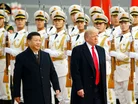
After moments of relative business-as-usual, renewed tensions between the US and China are threatening the fragile trade truce, with major implications for business leaders, global supply chains and financial markets.
In a move to bolster domestic manufacturing, US President Donald Trump has threatened an additional 100% tariff on Chinese goods.
In response, the Chinese government has accused the US of “double standards” and is preparing its own countermeasures, raising the prospect of a renewed trade war.
Flashpoint: rare earth minerals
A key element of Beijing’s strategy involves tightening its control over rare earth minerals.
China is central to the global supply of these materials, with the International Energy Agency (IEA) estimating the country is responsible for around 61% of rare earth production and 92% of its processing.
These 17 elements are difficult to extract but are essential components in a vast range of modern products from smartphones and solar panels to the magnets used in electric car motors and computer hard drives.
The Chinese government has formalised restrictions on the processing technology and any unauthorised overseas cooperation involving these minerals.
Under the new measures foreign nations must now receive approval from Beijing before they can export products containing rare earths.
Exporters are also required to declare the intended use of the materials as an additional authorisation step, which Beijing states is designed to safeguard Chinese national security.
These rules largely appear to be an attempt to target overseas defence manufacturers, including those in the US, which rely on a steady supply of rare earths.
Market volatility and financial risks
The escalating rhetoric has had an immediate effect on financial markets.
President Trump reacted to Beijing’s move by taking to social media, where he claimed China was “becoming very hostile” – after, the S&P 500 share index closed down 2.7% on Friday 10 October 2023, its largest fall since April.
In Asia the Shenzhen Component Index fell by more than 2.5% while Hong Kong's Hang Seng index was approximately 3.5% lower.
Experts have warned that without a resolution the S&P 500 could face a further 11% drop.
Days later Trump appeared to soften his tone on social media saying “Don't worry about China, it will all be fine!”
He added: “Highly respected President Xi just had a bad moment. He doesn't want Depression for his country, and neither do I. The USA wants to help China, not hurt it!”.
This followed an earlier agreement in May to drop triple-digit tariffs, an agreement many economists now fear is in jeopardy.
Diplomatic truce hangs in the balance
A meeting is scheduled between President Trump and President Xi later this month but it’s uncertain whether the two sides will convene as planned if current tension persists.
Trump’s proposed 100% levies on Chinese products are set to take effect from 1 November, which would officially end the carefully constructed truce established earlier in the year.
The Chinese commerce ministry criticised the tariff threat as a “double standard” and defended its own export controls.
A spokesperson for China explained the US had long “overstretched the concept of national security, abused export control measures” and “adopted discriminatory practices against China”.
The spokesperson added: “Resorting to tariff threats is not the right way to engage with China. China's position on a tariff war has always been consistent: we do not want one, but we are not afraid of one.”
The continued back-and-forth between the two global powers continues to strain relations, creating an unstable environment for international businesses.
While we’re not there yet, a full-blown trade war would inevitably impact global trade and disrupt supply chains across numerous sectors worldwide.