
Climate Group CEO Helen Clarkson on Leadership and Action

Helen Clarkson, Chief Executive of international non-profit Climate Group, used the recent Climate Week NYC 2025 to outline a strategy built on systems change, collaboration and policy leadership.
Her message to business leaders is clear: climate action is not a side project. Rather, it is central to corporate resilience and competitive positioning.

Across global markets, companies face mounting regulatory shifts, investor expectations and supply chain pressures linked to climate change.
Helen's approach draws directly on this complexity, aiming to embed climate strategy within business systems and government policy simultaneously.
Based in London, Helen leads Climate Group’s operations across five major hubs, including Amsterdam, New York, New Delhi and Beijing. Her team engages over 430 businesses and a coalition of subnational governments worldwide to drive faster transitions in renewable energy, clean transport and industrial decarbonisation.
From humanitarian roots to climate system strategist
Helen's leadership model reflects a practical, systems-based mindset shaped by early experience in humanitarian aid.
“I wanted to do humanitarian work at college, so I trained as an accountant to get the skillset organisations needed,” she says.
Trained as an accountant, she worked with Médecins Sans Frontières in the Democratic Republic of Congo, where environmental disruption and public health intersected visibly.
“You could see this direct link from how much rain there was to women’s health – not just the physical, but psychological pressures when seasons failed, and women were often left to run the households and work the land while men looked for work in cities,” she explains.
This experience formed the foundation for her work in sustainable development, advising major global brands like Nike and Walmart on integrating environmental goals into core business functions.
She recalls a moment when companies including Ingersoll Rand and Unilever “shifted from seeing sustainability as someone trying to persuade the business to print less, to building it into long-term strategy."
Climate Group’s approach: collective leverage and policy design
Helen's Climate Group strategy is grounded in system change theory: “We have a theory of change at Climate Group that’s based on systems change: we apply that to key systems like heavy transport, industry, renewable energy and we’re starting to work on food," she says.
The focus is sector-specific transformation, using business coalitions to reshape policy frameworks and market norms.
“Our mission is to drive climate action fast,” she adds. “We do that by building big networks of companies and governments, then harnessing that collective power to shift policy and push markets.”
Programmes target areas including heavy transport, renewables, industry and food.
The model involves identifying barriers, such as regulatory hurdles or technology access, then activating demand signals through collective business engagement.
In South Korea, Climate Group highlights policy gaps preventing corporate access to renewables.
In China, it facilitates alignment between national green energy certificates and global RE100 standards, enabling firms to source verified clean electricity. “It’s not just about showing up from London with policies to impose. We work with local organisations, refining policy work around what’s really needed in specific countries,” Helen explains.
“These are quite big things – now companies can buy certificates in China, which matters for their electricity transition.”
Climate Group also serves as secretariat for the Under2 Coalition – the world’s largest network of subnational governments committed to net zero by 2050. This includes policy capacity-building in regions like India, where the organisation supports knowledge exchange through its ‘Future Fund’.
Climate Week NYC: convening power and competitive positioning
At the centre of Helen's external engagement strategy is Climate Week NYC. First held in 2009, the event now hosts nearly 900 affiliated meetings annually alongside the UN General Assembly. Helen describes the gathering as a climate “engine for happenstance” and a critical point for public-private alignment ahead of the COP summits.
“It’s a very powerful point in the climate agenda – it serves to shape up what’s coming for COP,” she explains.
The Climate Group-curated programme includes The Hub Live and an Opening Ceremony, where dealmaking, announcements and technical roundtables take place.
“We did one last year on the first responsible steel-certified refinery. A small but focused group of a hundred people made real progress there,” Helen says.
Announcements made at the event often signal broader market trends. In 2024, L’Oréal pledged €15m to its Climate Emergency Fund. California’s Governor Gavin Newsom chose Climate Week NYC to reveal new legislation targeting fossil fuel misinformation.
“It draws attention to the topic – half the people who get on stage feel they have to say something big,” says Helen.
Preparing for COP30 and navigating geopolitical headwinds
As attention turns to COP30 in Brazil, Helen positions Climate Week NYC 2025 as a critical staging ground for national and corporate climate plans. The emphasis is on implementation – moving from targets to delivery, despite shifting political priorities in key markets like the United States.
“Last year was about how to deploy funds at speed and scale. This year, it’s about how we keep going despite challenges,” Helen comments.
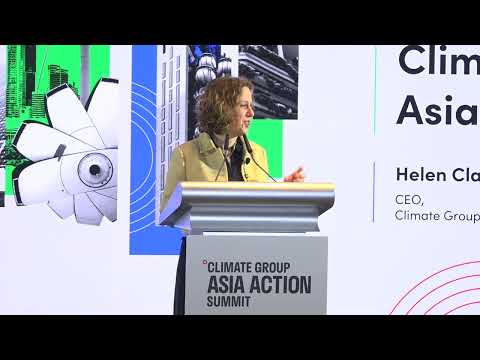
Helen remains confident in corporate momentum, particularly from US businesses navigating policy shifts while maintaining international competitiveness.
Despite headwinds, including changing US political priorities and regulatory uncertainty, “a lot of our members are US-based. We’re hearing from them – ‘no, we’re still doing this’,” Helen reports. “They’ve set long-term strategies and have to navigate their competitiveness in markets in the US, Europe, Asia and elsewhere. They’re looking to discuss with peers how to do that – and that makes this Climate Week NYC critical.”
She also highlights regional dynamics, citing Climate Group’s Asia Action Summit in Singapore.
“The competitive drive coming from Asia is amazing,” Helen adds. “We had people from the investment sector on stage, and none of them saw companies changing their climate strategies. They’re going ahead.”
For business leaders shaping post-2030 strategy, Helen advises a global outlook.
“For the next 18 to 36 months, attention will be pulled west, but we need to keep eyes everywhere. Those attending Climate Week should come ready to have a conversation about action – our goal is to keep pushing forward, to power on.”
Company portals

Executives
Helen Clarkson
Chief Executive Officer