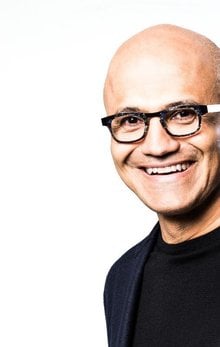
How CEO Satya Nadella Reset Culture at Microsoft

When Satya Nadella became CEO of Microsoft in 2014, he inherited a highly competitive internal culture.
Success had too often been measured by how individuals outshone peers, rather than how teams delivered lasting impact. Satya, who joined the business in 1992, made culture a priority, setting out to move Microsoft from knowing it all to learning it all.
In a 2025 conversation on digital growth with Microsoft, Satya said: “Achieving our mission requires us to evolve our culture. It all starts with a growth mindset – a passion to learn and bring our best every day to make a bigger difference in the world.”
A simple framework for leaders
Microsoft distilled its leadership expectations into a practical framework called ‘Model, Coach, Care’, which was developed over two years using employee feedback, focus groups and surveys.
The framework asks leaders to set the tone by example, create space for growth through coaching and demonstrate empathy that builds trust.
Focused on three pillars – setting an example (modelling), fostering growth (coaching) and showing empathy (caring) – the approach is designed to empower employees, foster innovation and deliver business success.
Its simplicity makes it portable across businesses and geographies, yet it is grounded in specific behaviours managers are expected to live every day.

Rethinking performance to reward impact
Cultural change required new performance rituals. Microsoft moved away from stack ranking – which forced managers to label a fixed percentage of people as underperformers – and towards conversations about impact, potential and mobility.
The company’s ‘Talent Talks’ bring senior leaders together with the CHRO and Satya to discuss the depth of talent, high‑potential employees and pathways for development inside the business.
When this new framework was introduced in 2018, Kathleen Hogan, Executive Vice President of Strategy and Transformation at Microsoft, said: “We needed some way for our leaders to be accountable to building organisational capability, to ensure that our processes were rigorous and our CEO could get an end-to-end view of the depth of our talent.”
This “forward-looking” approach, she explained, makes it easier for Microsoft to “avoid being blindsided and also helps cultivate talent in a way that encourages career growth".
Making learning a leadership habit
Satya has consistently framed learning as a core leadership discipline. The goal is not only to create psychological safety but to normalise curiosity, experimentation and the productive use of failure.
Speaking on the Hello Monday podcast, he said of this model: “If you take two kids at school, one of them has more innate capability but is a know-it-all. The other person has less innate capability but is a learn-it-all. The learn-it-all does better than the know-it-all”.
That stance has become more prominent as Microsoft deepens its work in AI.
In a conversation with the MD Meets podcast in 2025, he explained: “Even today as I sit around this entire weekend, I spent all the time trying to get myself to understand how new compares are building products which are different than say how we built our products.”
Adding that Microsoft is built around trust and empowerment reinforced with a culture of learning, he said: “I always go back to a sense of purpose and mission and culture, reinterpreted for what is a new world of technological shift and business model shift.”
Company portals

Executives
Satya Nadella
Chairman and CEO