How C-Suite Leaders Can Tackle ESG Reporting Pressure

Regulatory frameworks for sustainability reporting are evolving at an increasingly frenetic rate, with expectations from regulators, investors and stakeholders changing at the same time.
The European Commission continues to advance its reporting frameworks and, as a result, companies are under pressure to demonstrate that their ESG and non-financial priorities are both relevant and defensible.
According to Datamaran, many companies still rely on static assessments that quickly become outdated – an approach that could create a gap between strategy and reality.
Datamaran, an AI-powered business that helps business leaders monitor and manage their sustainability commitments, has enhanced its Core platform in response.
The solution helps organisations monitor, prioritise and govern sustainability risks and opportunities.
ESG intelligence for compliance
According to the European Commission, EU law requires companies above a certain size to disclose information on potential risks and opportunities arising from social and environmental issues.
They must also disclose their impact on people and the environment.
The aim is to help investors, civil society organisations and stakeholders evaluate the sustainability performance of companies. This forms part of the European Green Deal.
The updates to Datamaran Core are designed to transform sustainability strategy from an ad-hoc exercise into an ongoing process that is evidence-based and data-driven.
- The European Green Deal is transforming the EU into a modern, resource-efficient and competitive economy.
- Launched by President Ursula von der Leyen in 2019, it responds to citizens’ urgent call for climate action, setting out a plan to transform Europe’s economy, energy, transport and industries for a more sustainable future.
- It aims to cut emissions by at least 50% by 2030, rising towards 55%, while legally binding the 2050 neutrality goal through the European Climate Law.
Updating external signal monitoring capabilities can allow companies to track regulatory developments, peer disclosures and value chain changes in real time.
This could help identify emerging sustainability risks before they escalate.
The platform's enhanced Dynamic Stakeholder Intelligence Matrix enables organisations to assess evolving stakeholder expectations. It also allows them to address potential gaps between business strategy and external priorities.
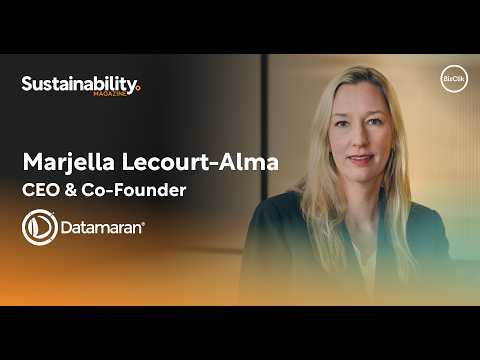
"These enhancements give organisations a structured, data-driven way to continuously identify, prioritise and monitor the risks and opportunities that shape their business," says Marjella Lecourt-Alma, CEO and Co-Founder of Datamaran.
Workflow architecture and benchmarking
Datamaran's upgraded collaboration architecture introduces role-based workflows and stakeholder survey tools. This supports broader participation across business functions.
The release also strengthens the platform's double materiality capabilities through features such as the IRO Industry Landscape. This benchmarks impacts, risks and opportunities against audited CSRD peer reports.
AI-generated IRO recommendations provide organisations with evidence-based suggestions. These can be integrated directly into reporting workflows.
"Datamaran Core brings structure, transparency and continuous intelligence into the process," says Ian van der Vlugt, VP, Market Leader, Insights & Training, at Datamaran.
"Whether it's for enhancing governance and strategy or for specifically complying with ISSB or CSRD, the platform has you covered."
Navigating complex disclosure requirements
Datamaran Core is built on intelligence gathered from nearly 10,000 companies. It also draws from regulatory sources across more than 190 jurisdictions and global media coverage.
The platform is positioned to help organisations navigate sustainability requirements. These requirements are becoming more complex.
The platform supports compliance frameworks, including CSRD and ISSB. It enables companies to strengthen governance and continuously validate strategic priorities against external developments.
As more businesses prepare for expanded sustainability disclosure obligations, AI-driven platforms such as Datamaran are playing a role. They could help organisations build resilience, improve transparency and embed sustainability into decision-making.
"With Datamaran, we have an objective, data-driven process that brings rigour and defensibility to our strategy," says the Director of a Fortune 500 Financial Institute.
"The platform has delivered nearly 90% efficiency gains and significantly reduced costs, while enabling us to do more analysis, engage more stakeholders and justify our decisions with clear evidence – something that's increasingly critical."
Company portals

Executives

Ian van der Vlugt
VP, Market Leader, Insights & Training
Marjella Lecourt-Alma
Advisory Board Member