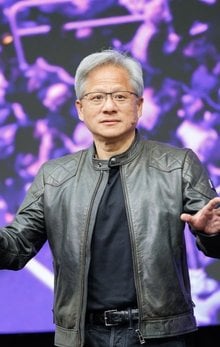
Why Did King Charles Warn Nvidia's CEO on the Risks of AI?
It's rare that the architects of the mammoth AI infrastructure engulfing the world are recognised outside of their own technology circles.
That changed recently, in an event that saw Nvidia's leadership recognised for the foundational work the company has achieved in advancing AI and presented with a pointed reminder of the responsibilities that come with such powerful advances,
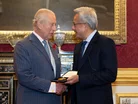
On 5 November, Nvidia Founder and CEO Jensen Huang and Nvidia’s Chief Scientist Bill Dally were awarded the 2025 Queen Elizabeth Prize for Engineering. His Majesty King Charles III presented the prize for their key contributions to modern machine learning.
The ceremony, however, gained another layer of importance when the King gave Jensen a personal letter outlining his thoughts on AI’s development.
Royal correspondence on AI risks
The letter from King Charles contained a copy of his 2023 address from the world's first AI Summit.
In the speech, he warned that AI's risks require tackling with “a sense of urgency, unity and collective strength” and described advanced AI's development as being “no less important than the discovery of electricity.”
Jensen explained to the BBC: “He said, there’s something I want to talk to you about. And he hands me a letter. It is his speech on AI safety. He obviously cares very deeply about AI safety.”
According to Jensen, the King’s message navigates a line between optimism and concern. “He writes in his speech that he believes in the incredible capability of the technology to transform the UK and the world," Jensen said.

“But he also wants to remind us that the technology could be used for good and for evil, and so to make sure we do everything we can to advance AI safety.”
The prize itself honours the work of Jensen and Bill in developing the accelerated computing that underpins modern AI. The citation notes that this breakthrough is causing a fundamental change across the computer industry, from chips and systems to algorithms and applications.
“To be recognised among the pioneers whose work has shaped the world we live in today is an extraordinary honour," Jensen said.
“We are living through the most profound transformation in computing since the invention of the microprocessor. AI has become essential infrastructure, as vital to future progress as electricity and the internet were to previous generations.”
Deepening UK ties and engineering focus
Later the same day, Jensen’s contributions were further recognised as he received the Professor Stephen Hawking Fellowship at the Cambridge Union, the world’s oldest debating society.
Presented by Lucy Hawking, daughter of the late professor, the fellowship commends individuals who advance STEM and public understanding of these fields.
“Professor Hawking’s life shows that intellect has no boundaries," Jensen said. “He teaches us that discovery is an act of optimism. And I can think of no higher compliment than to be associated with that spirit.”
Earlier, Jensen and Bill participated in a roundtable with UK government figures, including Secretary of State for Science, Technology and Innovation Liz Kendall.
The discussion, held on National Engineering Day in the UK, focused on inspiring the country’s next generation of engineers. This builds on Nvidia’s existing collaborations with the UK government, universities and industry to grow AI infrastructure, research and skills development.
Bill credited the foundation of today's AI to sustained progress in other fields. “We continue to apply engineering methods to refine AI hardware and software so that AI can empower people to achieve even greater things," he said.
Navigating global AI opportunities
The award ceremony also recognised Professors Yoshua Bengio and Geoffrey Hinton, who both publicly state that AI could pose a major threat to humanity. Their inclusion highlights a tension within the technology sector.
While some advocate for caution, others, including US President Donald Trump, urge for more rapid advances.
This contrasts with US Secretary of Commerce Howard Lutnick, who reportedly discourages using the word “safety” because “it makes us sound like we’re afraid.”
Amid these differing global perspectives, Jensen sees a distinct opportunity for the United Kingdom.
With large US technology firms like Nvidia investing billions to build UK-based AI infrastructure in the form of data centres, which Jensen refers to as “AI factories,” the stage could be set for substantial growth.
He describes the current moment as “an industrial revolution that’s happening right now.” For the UK, Jensen says, “It’s your opportunity to grasp.”
Company portals

Executives
Jensen Huang
Founder and CEO