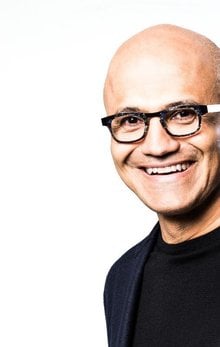
Empathy or Intelligence? Satya Nadella’s AI Success Secrets
As AI is used more in workplaces to complete everyday tasks and develop new ideas, many business leaders, including Dell CEO Michael Dell and Nvidia CEO Jensen Huang, have expressed that the tech should augment human work, not replace it.
Microsoft CEO Satya Nadella has emphasised the need for human qualities alongside AI, saying that empathy is now a crucial business skill rather than a soft skill.
Speaking on the MD Meets podcast, hosted by the CEO of Business Insider’s parent company Mathias Döpfner, he said that as AI handles more technical tasks, emotional intelligence, or EQ, is growing more and more important.
Satya says: “IQ has a place, but it’s not the only thing that is needed in the world. And I’ve always felt at least as a leader, you know, if you have IQ without EQ, it’s just a waste of EQ.”
“Empathy requires us to understand the context a little better,” Satya says, “but at the same time not be too dogmatic on the two ends.”
He adds that this coincides with people generally wanting to interact in person more than ever: “Conferences are booming, social events are booming, life events are booming because it is about the interaction."
You see that as a kind of general trend of civilisation that EQ becomes more important than IQ.
Why Satya isn’t bored of AI
When asked by Mathias if he’s bored of being asked about the topic, the CEO says that you can get bored, but adds “you just are excited every day, you thank yourself that we get to sort of do what we do in terms of building these technologies, but ultimately it’s the use of the technologies that needs to be celebrated”.
Satya spoke about Bill Gates and how, when he founded Microsoft in 1975, the concept of a software industry didn't exist at the time, and he was the start of it all.
Now that the industry is saturated, Satya says “that’s where you’ve got to go back to your core mission”.
He adds that Microsoft has been built around “trust and empowerment reinforced with a culture of learning”.
“I always go back to a sense of purpose and mission and culture,” Satya says, “reinterpreted for what is a new world of technological shift and business model shift.”
Leading in AI
The tech leader admits in the interview that at the start of the AI-wave, he wasn’t a pro in the field, and he wanted to give his developing skills the best shot at long-term relevance by being a “learn-it-all” not a “know-it-all”.
Satya adds that with success this becomes harder to achieve as he has to unlearn things that made the success in order to create new developments.

He says: “Even today as I sit around this entire weekend, I spent all the time trying to get myself to understand how new compares are building products which are different than say how we built our products.”
Firms around the world have seen and survived the original digital wave, whether this be office management tools or CRM systems, but Satya says that the AI wave offers a level of complexity in the corporate world.
“If the entire thing is about one model that knows it all,” he says, “then the question that needs to be answered by every company is what do I know that is unique?"
More importantly, how do I even play the game?
To compete against one another and use AI specifically for company purpose, Satya says: “It’s not about celebrating someone else’s foundation model because the future of every company will be some unique foundation model that they have that represents their knowledge.”
Throughout the podcast, Satya encourages leaders to think with emotional intelligence amongst the AI wave to keep the context at the forefront of leadership to enable unique software developments per company.
Company portals

Executives
Satya Nadella
Chairman and CEO