
How CEOs Adapt to AI and M&A Amid Economic Uncertainty

Amid uncertainty in the global economy, growing geopolitical tensions, persistent volatility and rising cost pressures, leaders are faced with challenging strategic decisioning and ongoing restructuring of operations to keep pace on performance.
This mindset has been on show in Davos at the World Economic Forum 2026, where Microsoft CEO Satya Nadella discussed the role of AI in shaping the global economy’s ongoing technological transformation.
Away from technology, Amazon CEO Andy Jassy shared an honest outlook on how President Trump’s tariffs are now affecting the firm’s pricings.
Outside of Microsoft and Amazon, global CEOs are taking steps to progress their business against challenging conditions. According to an EY-Parthenon CEO Outlook Survey published on 20 January, business leaders are more confident in their companies’ prospects than they are in the outlook for the global economy.
In the quarterly survey of 1,200 global CEOs across 21 countries, the CEO Confidence Index shows that overall sentiment has dipped from 83.0 in Q3 of 2025 to 78.5 in Q4 of 2025. The index measures this sentiment from 1 to 100 across a range of business areas.

CEO confidence remains
Nine in 10 respondents show they are confident in their ability to strengthen performance from within, expecting revenue and productivity growth to support their companies’ profitability in 2026.
Sixty-one percent expect this will increase operating costs, but leaders remain willing to act.
The survey shows that CEO respondents are more likely to accelerate investments in response to geopolitical or trade policy developments at 40%, than:
- Delay (31%)
- Stop investment activity (10%)
EY Global Chair and CEO Janet Truncale says: “Today’s most successful CEOs are confident in their ability to operate under uncertainty, acting boldly to embrace new technologies at speed and foster confident collaboration to gain competitive advantage.
“In the year ahead [2026], business leaders need to execute decisively and intentionally by scaling innovation, investing in talent and working closely within their organisation and across industries to create new value.”
The power of AI
AI adoption is evolving, with EY recognising it no longer as an addition but a requirement of business models.
The survey shows that 58% of leaders are expecting AI to be a major growth engine in the next two years, while 32% believe it will fundamentally reshape operations as they scale these technologies enterprise-wide.
In addition to this, over half of respondents say they have begun significant transformation initiatives this year, with 45% saying they are planning to begin the same to increase business value.
Global Vice Chair of EY-Parthenon, Andrea Guerzoni, says: “Despite the hype around outsized gains, the reality for CEOs is much more complex.
“AI is meeting and somewhat exceeding expectations for many CEOs, but only a standout 20% are capturing breakthrough returns, and they will be in a strong position to forge ahead, making AI more of an engine than an experiment.”
He adds that this reflects the fact that CEOs “are taking a realistic and pragmatic view on the need to add new skillsets”.
Mergers and acquisitions as a tool for CEOs
M&A is on the rise as a necessity within CEO strategy. Seventy nine percent of respondents are planning joint ventures and strategic alliances in 2026, an increase of 17% from the previous year.
But this is not without awareness of the business environment, as 83% of the CEOs in the survey have adapted their strategic investments in the past 12 months as a response to trade policy developments. At the same time, 40% have reported an acceleration in investment for the same reason.
“2026 is not going to be a year of certainty, and CEOs know this,” Andrea adds. “The winners will be those who actively rewire their capital allocation, navigate geopolitical complexity and focus on technology-led M&A to fashion flexible, resilient portfolios that are built not only to absorb further potential market shocks, but also to maximise opportunities presented by ongoing market volatility.”
Company portals

Executives
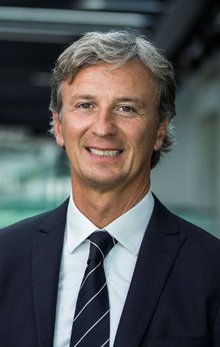
Andrea Guerzoni
Global Vice Chair

Janet Truncale
Global Chair and CEO