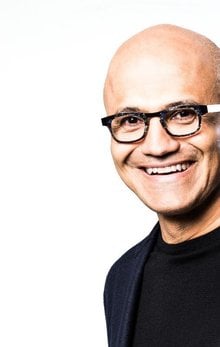
Inside CEO Mustafa Suleyman’s Vision for Microsoft AI

Microsoft AI CEO Mustafa Suleyman is entering his second year as the leader of the tech firm’s division.
He leads Microsoft’s efforts in consumer AI products, research and the development of its Copilot assistant, reporting to Microsoft CEO Satya Nadella.
Having joined Microsoft in early 2024 to head this new division, his strategy focuses on practical AI applications, safety and developing AI with distinct personalities.
Mustafa brought years of AI experience into the role as Co-Founder of DeepMind - which was later acquired by Google - and Inflection AI.
These two platforms show his commitment to focusing on the consumer experiences of AI in everyday life.
Discussing his appointment at the time, Satya said in a note to Microsoft employees: “I’ve known Mustafa for several years and have greatly admired him as a Founder of both DeepMind and Inflection, and as a visionary, product maker and builder of pioneering teams that go after bold missions.”
The AI division was created to accelerate innovation, integrate AI into its entire product stack and maintain a competitive edge in the rapidly evolving AI-market, and Mustafa has done just that.
Success at Microsoft AI
Since joining Microsoft to lead the division, the CEO has shifted Microsoft’s AI (MAI) strategy to focus on developing Human Superintelligence (HSI).
Discussing this strategy on the MAI blog in November 2025, Mustafa said: “At Microsoft AI, we’re working towards Human Superintelligence: incredibly advanced AI capabilities that always work for, in service of, people and humanity more generally.
“We think of it as systems that are problem-oriented and tend towards the domain specific. Not an unbounded and unlimited entity with high degrees of autonomy - but AI that is carefully calibrated, contextualised, within limits.”
He added that this allows the division to explore and prioritise how even the most advanced forms of AI can keep humanity in control, but also “accelerating our path towards tackling our most pressing global challenges”.
As CEO, he has also built a proprietary in-house MAI Superintelligence Team with a mission to build frontier-grade models. Karen Simonyan, a key member of this team as Chief Scientist, joined alongside Mustafa from Inflection AI.
The team also includes researchers with experience from other leading AI makers, including Google DeepMind, Meta, OpenAI and Anthropic.

Technical achievements as head of AI
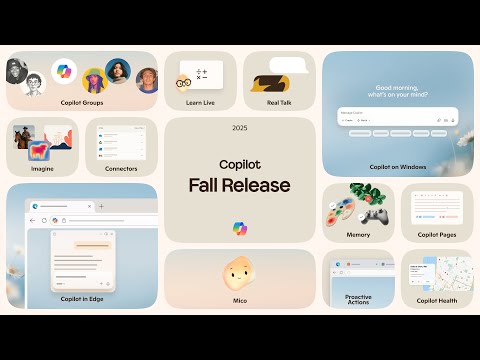
Most significantly, Mustafa has overseen significant upgrades to Microsoft’s Copilot AI assistant, focusing on making it a more personalised companion that can take actions with what the user asks of it.
This includes having a longer memory, so the software can remember past conversations and understand user preferences over time. This allows for more seamless interactions without so much repetition needed.
The addition of “actions” allows Copilot to perform more complicated tasks, whether this be organising a reservation or booking transport, through using the user’s browser.
These developments continue to happen with an ethical mindset, according to Satya. He shared in a personal blog at the start of January that he acknowledges that Copilot has a long way to go but is making significant moves.
He said: “We have learnt a lot in terms of how to both keep riding the exponential of model capabilities, while also accounting for their jagged edges.
“We need to make deliberate choices on how we diffuse this technology in the world as a solution to the challenges of people and the planet.”
AI alignment
While Mustafa is pushing for AI to be for the needs of humans, he is aware that the scope of AI means it is something developers need to adapt to.
Discussing AI alignment, the research field focused on ensuring AI systems act in accordance with human values, he shared in a post on LinkedIn on 9 January: “I worry we’re putting the cart before the horse. You can’t steer something you can control.
“People often talk about containment and alignment in the same breadth, but they’re not interchangeable or a package deal.”
The executive explained that containment is where developers can set boundaries on AI, whereas alignment is about “ensuring it shares our values” and that it “serves humans’ best interests”.
“Containment has to come first. Otherwise alignment is the equivalent of asking nicely.”
Company portals

Executives
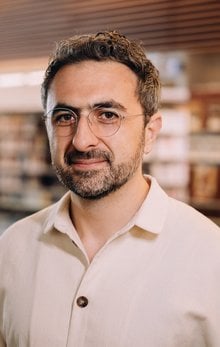
Mustafa Suleyman
CEO of Microsoft AI
Satya Nadella
Chairman and CEO