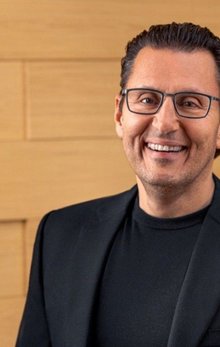
Intuit’s CEO: Lead With Grit & Resilience in the AI Era

While many companies are revamping talent strategies to focus on AI skills, Sasan Goodarzi, CEO of Intuit, is prioritising something harder to teach – grit.
At the Wall Street Journal Leadership Institute’s Technology Council Summit in Silicon Valley, Sasan said: “I was interviewing somebody yesterday, and the whole time my focus was do you actually have the grit?”
According to Sasan, employees who “know how to go through pain and suffering”, are more likely to drive long-term business success and foster agility.
Developing this grit and resilience has shaped his own leadership strategy, Sasan says, as it encourages him to think “tomorrow will be a better day”.

Leading through volatility
For Intuit, this stance on resilience informs key strategies in a rapidly shifting market.
Since taking the helm as CEO in 2019, Sasanhas pushed for pace, focus and durability across the organisation – with visible results.
Sasan says: “When I took over, we were growing like 8% to 9% and we were about US$4bn in size. We’re now US$20bn in size, and we’re growing double the rate”.
The wider business context is unforgiving, however, with AI disrupting software models and investor expectations.
In December 2024, Microsoft CEO Satya Nadella shared on the BG2 podcast that he believed that SaaS applications will “all collapse, right in the agent era”, as “once the AI tier becomes the place where all the logic is, people will start replacing the back ends”.
With further developments in AI, Intuit’s stock has fallen to a 52-week low in February 2026, down 30% over the year.
For Sasan, pressure clarifies priorities, seeing turbulence as a moment to steady teams and keep execution tight.
“When there’s so much turbulence around us, I’m built for these moments,” he says.
Turning principles into practice
Embedding this approach to leadership within the company's culture and operating model requires a robust hiring strategy.
Intuit has developed an ‘Assessing for Awesome’ (A4A) hiring model, which is designed to bring company culture into the interview process and keep standards anchored to real work. Candidates face craft-based evaluations that mirror on-the-job scenarios, putting judgement and delivery under scrutiny.
The process is led by ‘awesome assessors’ – high-performing employees who work closely with the role to be filled. They identify the capabilities required for success, which are then tested during selection.
Sherrey Whiteley, Intuit’s former Executive Vice President of People and Places, said: “We’re happy to say, it removes the bias in interviewing because it really focuses on the craft demonstration of the work that a candidate would do.”
Sherrey also shared that, since implementing this approach, hiring managers are “very invested in hiring top talent,” and that quality of hire has improved.
For the company, this is how resilience can become a part of its culture, driving long term growth by leaning into the disrupting force of AI.
Teams at Intuit are building a suite of AI tools called Intuit Assist, which are designed to automate manual financial tasks and provide customised business insights, to sharpen customer value and rebuild higher profit margins.


Executives
Sasan Goodarzi
Chief Executive Officer
Satya Nadella
Chairman and CEO