NVIDIA's Workforce Vision: 100 AI Agents Per Employee
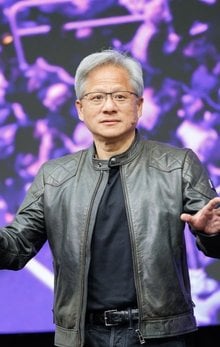
Jensen Huang is charting a course for workforce transformation at NVIDIA. The company's founder and CEO has revealed plans to deploy 100 AI agents for every employee by 2036, fundamentally reshaping how the technology giant operates and scales its business.
Speaking at NVIDIA GTC, Jensen told attendees: "In 10 years, we will hopefully have 75,000 employees, as small as possible, as big as necessary. They're going to be super busy. Those 75,000 employees will be working with 7.5 million agents."
The announcement signals NVIDIA's intention to increase its headcount by more than 30,000 workers over the next decade whilst simultaneously deploying millions of AI agents. These digital workers will be "working around the clock. So hopefully our people don't have to keep up with them," Jensen says.

Scaling through continuous innovation
Jensen outlined NVIDIA's growth strategy at GTC, where he projected the company could secure US$1 tn in orders by 2027. Central to this ambition is continuous innovation designed to deliver what he describes as a "continuous cost reduction of accelerated computing over time" for customers.
According to Jensen, this approach creates a virtuous cycle where new optimisations can be used by millions. "This combination of dynamics is what makes NVIDIA architecture expand its reach, accelerating its growth at the same time driving down computing costs. Which ultimately encourages new growth," he says.
The company has expanded its workforce as it develops its AI capabilities, growing from 29,600 people at the end of fiscal 2024 to 42,000 by March 2026.
Jensen has positioned himself as an advocate for AI integration in the workplace.
In a meeting reported on by Business Insider in November, he said: "My understanding is that Nvidia has some managers who are telling their people to use less AI. I want every task that is possible to be automated with AI to be automated with AI. I promise you, you will have work to do."
Discussing the use of AI at NVIDIA, Jensen advised employees: "If AI does not work for a specific task, use it until it does, jump in and help make it better, because we have the power to do so."
Reimagining organisational structures
"This will also fundamentally change the role of HR," Jensen says. In an interview with Citadel Securities in October, he shared his belief that AI agents will one day be employed just like people – eventually going through a hiring and orientation process to absorb the culture of an organisation.
Jensen said this would mean "future workforces in enterprise will be a combination of humans and digital humans."
Other organisations are following similar trajectories. Accenture has reportedly started tracking its staff's use of AI tools, according to an internal email the Financial Times saw. The company says it will take this data into account when making decisions on who to promote.
Discussing this move on the Rapid Response podcast, Julie Sweet, CEO of Accenture, said: "This is Accenture, and how we operate. If you want to get promoted, you've got to do the things that we do."
The company announced it was laying off 11,000 employees in September who could not be reskilled for AI related work. These layoffs reportedly focused on roles centred on tasks that can now be automated.


Executives
Jensen Huang
Founder and CEO
Julie Sweet
Chair