The 2025 CEO Playbook: Innovation, Empathy and AI

In 2025, some of the world’s top CEOs are showing that leadership isn’t just about making big decisions or hitting targets. It’s about experimenting, thinking differently and knowing when to let technology take the wheel.
More than ever, leaders are balancing AI tools with human judgment, proving that being a CEO now is as much about curiosity and adaptability as it is about strategy.
AI is changing the game, but it’s not replacing the human touch. Leaders are finding clever ways to use technology to make work faster and smarter, while still keeping empathy and people skills front and centre.
The CEOs who are standing out in 2025 aren’t just using AI, they’re rethinking what it means to lead in a fast-moving, tech-heavy world.
Klarna tries an AI clone
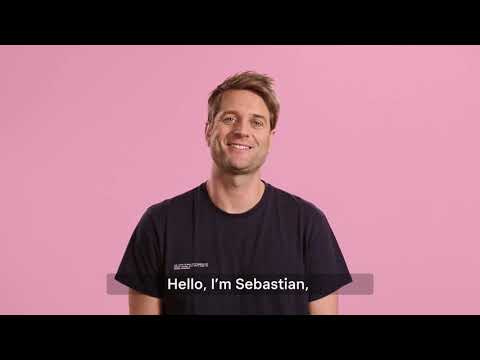
If you ever thought about skipping a meeting, Sebastian Siemiatkowski has taken it to a whole new level.
In October, Sebastian used an AI version, or clone, of himself to present Klarna’s first quarter 2025 results. The avatar opened by saying, “It’s me, or rather my AI avatar, here to share Klarna’s Q1 2025 highlights.”
The AI laid out some impressive numbers. Klarna reached 100 million active consumers, delivered its fourth consecutive profitable quarter and saw revenue rise 15%, with the US driving 33% of that growth.
The avatar credited the success to AI, saying, “AI is helping us work faster, scale faster and deliver more value. From customer support and marketing to insights and product development, we’re now on track to hit US$1m per employee.
“One hundred million consumers, profit and growth. AI is the engine driving it all.”
Since 2022, Klarna has streamlined its workforce by around 40% while increasing its share of tech employees from 36% to 52% in early 2025.
Now 96% of employees use AI daily, which has driven a 152% increase in revenue per employee.
AI is also helping customer-facing work, with costs per transaction down 40% while keeping customer satisfaction steady.
Sebastian has been honest about AI’s impact on work, saying, “AI can already do all of the jobs that we as humans do because our work is simply reasoning combined with knowledge and experience.
“Exactly how long it will take for the world to figure this out, who knows for sure? But I think we can all agree it is not in the hundreds of years.”
He also uses vibe coding, a way of working with AI as a coding assistant in a more fluid, informal way, which lets him test ideas quickly without disrupting his engineers and product teams.
Satya Nadella and his love for AI
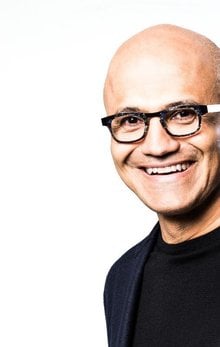
Microsoft CEO Satya Nadella loves to talk about AI, and whether or not people think Microsoft is winning the AI race, he has shared plenty of tips about using it to make leadership easier.
In September, Satya revealed how GPT-5 in Microsoft Copilot has become part of his everyday routine, helping him manage projects, meetings and priorities.
Satya uses AI to stay ahead of the day-to-day noise. One of his favourite prompts is: “Based on my prior interactions with [person], give me five things likely top of mind for our next meeting.”
He also asks: “Draft a project update based on emails, chats and all meetings in [series]: KPIs vs. targets, wins and losses, risks, competitive moves, plus likely tough questions and answers.”
He has Copilot checks whether products are on track for launches, estimates the probability of hitting targets and summarises how he has spent his time over the past month. It even helps him prep for meetings by reviewing previous discussions.
For Satya, AI isn’t about replacing leadership. It’s about clearing space to focus on decisions that matter.
He isn’t alone, as OpenAI CEO Sam Altman uses AI for email summaries, meeting prep and translation.
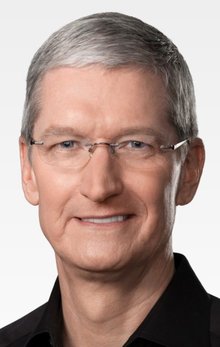
Apple CEO Tim Cook said: “If I can save time here and there, it adds up to something significant across a day, a week a month. It’s changed my life, it really has.”
Empathy beats intelligence
As AI handles more tasks, Satya argues that emotional intelligence is now a key business skill.
On the MD Meets podcast in December, he said: “IQ has a place, but it’s not the only thing that is needed in the world. And I’ve always felt at least as a leader, if you have IQ without EQ, it’s just a waste of EQ.”
He added: “Empathy requires us to understand the context a little better, but at the same time not be too dogmatic on the two ends.
“Conferences are booming, social events are booming, life events are booming because it is about the interaction. You see that as a kind of general trend of civilisation that EQ becomes more important than IQ.”
Satya’s advice for leaders is to stay curious, keep learning, and use AI to support people, not replace them.



Executives
Satya Nadella
Chairman and CEO
Sebastian Siemiatkowski
Co-Founder / CEO
Tim Cook
Executive Chairman