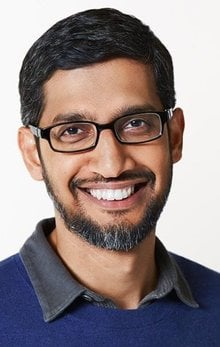
What Does Google CEO Sundar Pichai Really Think of OpenAI?
AI exploded into the public-sphere when OpenAI launched ChatGPT in 2022 - initiating a new era for the technology by making it accessible to all on the internet.
The fast release of the chatbot left several tech giants behind, including Apple, despite its long-standing leadership in AI.
Sundar Pichai, CEO of Google and its parent company Alphabet, shared his reaction to the release of ChatGPT at Salesforce’s annual technology event, Dreamforce, on 17 October.
Host and Salesforce CEO Marc Benioff asked how Google reacted as the “absolute leader in AI” when “this little company in San Francisco called OpenAI” took the lead with ChatGPT’s launch.
In response, Sundar said that Google was already developing a chatbot at the time but the technology wasn’t there yet.
“We were making a lot of progress”, he said, “but credit to OpenAI, you know, they put it out first”.
When OpenAI launched ChatGPT in November 2022, the Sam Altman-led startup already had backing from Microsoft - one of Google’s key AI-rivals.
A report from The New York Times suggested that Google had even issued “code red” over Chat GPTs popularity, with Sundar reportedly telling several groups in the company to focus their efforts and resources to work on commercial AI prototypes and products.
In conversation with Sundar Pichai
Discussing the surprising launch of ChatGPT, Sundar said: “We knew in a different world, we would’ve probably launched our chatbot maybe a few months down the line.
“We hadn’t quite gotten it to the level where you could put it out and people would’ve been okay with Google putting out that product.”
He added that there were still a lot of errors with the product and there was “a lot of risk putting it out at that point”.
Sundar said that “contrary to belief”, when ChatGPT launched he was excited because “the window had shifted”.
“We had been building this tech for so long, we were so AI native," the tech CEO added, “I had decided to take a full stack approach to AI, we were investing all the way from infrastructure, we built out own chips, we had world class research teams: Google Research, Google Brain, Google DeepMind.”

He said he used the “biggest opportunity in technology” to “seize the moment and execute well as a company”.
Google has been rapidly iterating since then, bringing together Google Research and Google DeepMind to develop Gemini models - the company’s personal AI assistant.
Sundar also discussed their largest investment outside the US, a US$15bn data centre that is 80% powered by clean energy.
History of AI at Google
Google says that their AI journey started with ‘ML for spell check’ in 2001 and Google Translate in 2006. Other AI developments include:
- Acquisition of DeepMind in 2014 - one of the leading AI research labs in the world
- Google Photos in 2015 - an app that uses AI to search for and access memories by people and places
- Tensor Processing Units (TPU) in 2016 - the TPU custom data centre silicon built specifically for machine learning
- Smart Compose in 2018 - a feature in Gmail that uses AI to help users reply to their emails quicker

In December 2023, Google introduced Gemini, which it says is “our most capable and general model”, capable of combining different types of information including text, code, audio, image and video.
During the conversation at Dreamforce, Sundar confirmed that the next version of Gemini - called Gemini 3.0 - will be released later in 2025, but Google is yet to release the official launch date.
The exec acknowledged that big tech firms will continue to compete and release AI developments, comparing it to the social media spiral that came after the introduction of YouTube and Facebook.
Company portals



Executives
Marc Benioff
Chair & CEO

Sam Altman
Sundar Pichai
CEO