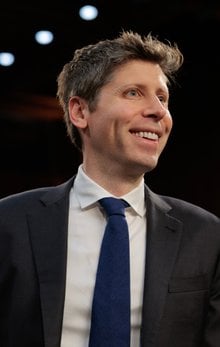
What is CEO Sam Altman's Leadership Strategy for OpenAI?
Sam Altman's leadership style is marked by urgency, competitive paranoia and long-term conviction, an approach that has helped turn OpenAI from a research lab into the dominant force in consumer AI and an increasingly powerful enterprise player.
The CEO leads with a belief that scale matters early, that products - not just models - create durable advantage, and that winning requires constant reinvention even from a position of market leadership.
That philosophy is evident in OpenAI for Healthcare, announced on 8 January, which offers a clear window into how Sam sees the company's next phase of growth.
The launch signals a deliberate move into regulated, high-impact industries while reinforcing OpenAI's mission to ensure AI benefits all of humanity.
By introducing secure, enterprise-grade products such as ChatGPT for Healthcare and expanding HIPAA-compliant API use across hospitals and health systems, OpenAI is diversifying beyond consumer tools without abandoning its core platform strategy.
Healthcare as a strategic move
Healthcare is not an incidental choice. It is a sector under intense strain, rich in data and constrained by regulation, conditions that reward technical leadership, trust and operational depth.
OpenAI's early partners, including Boston Children's Hospital, Cedars-Sinai, Stanford Medicine Children's Health and Memorial Sloan Kettering, suggest the company is prioritising credibility and scale over speed alone.
The focus on evidence-based reasoning, transparent citations, governance controls and strict data protections reflects a broader attempt to align commercial expansion with societal value.
This moves also reflects the OpenAI Charter's emphasis on "broadly distributed benefits" and "long-term safety", particularly its commitment to avoiding concentrations of power and ensuring AI deployment improves real-world outcomes.

Making the best models and building the best product
Sam's thinking on competition and growth was laid out clearly during his December 2025 interview on the Big Technology podcast. Speaking about how OpenAI responds to rising competition, Sam said: "It's good to be paranoid and act quickly when a potential competitive threat emerges," explaining that internal "code red" moments are designed to surface weaknesses and accelerate execution.
At the core of OpenAI's strategy, Sam was explicit: "The strategy is: make the best models, build the best product around it and have enough infrastructure to serve it at scale."
That framework helps explain why OpenAI prioritised customer adoption through ChatGPT before expanding aggressively into the enterprise markets. Sam argues that familiarity with consumer products lowers friction when organisations later adopt OpenAI tools at work.
Having said this, Sam argues that model performance alone will not determine long-term advantage. As models improve across the industry, he believes differentiation will increasingly come from product design, reliability and personalisation.
He has highlighted personalisation as particularly "sticky", arguing that people value AI systems that understand over time and adapt to their needs.

From chatbots to platforms
OpenAI for Healthcare reflects this product-first philosophy. Rather than positioning AI as a bolt-on tool, OpenAI is embedding its models directly into clinical and administrative workflows, including: automating documentation, synthesising evidence and aligning outputs with institutional policies.
This mirrors Sam's broader view that AI-native systems will outperform those that simply layer AI onto legacy processes.
Underlying this expansion is a willingness to invest heavily in infrastructure. Sam has repeatedly described compute as foundational to OpenAI's future, arguing that demand for intelligence will continue to outpace supply.
OpenAI's Charter placed clear constraints on how that power is used, stating that the company's "primary fiduciary duty is due to humanity" and commits the company to cooperation over competition if a safety-aligned organisation nears artificial general intelligence first.
Sam's leadership strategy is not about choosing between ambition and responsibility, instead scaling fast, diversifying thoughtfully and treating trust, safety and societal impact as competitive advantages. OpenAI for Healthcare signals how the CEO intends to lead the company forward by applying frontier AI to the necessary markets.