Anthropic and OpenAI CEOs Reverse Stance on AI Layoffs

Two chief executives who spent years warning that generative AI would eliminate white-collar jobs have changed their position. Sam Altman, CEO at OpenAI, and Dario Amodei, CEO at Anthropic, now acknowledge their predictions were incorrect.
Both companies are preparing for public listings in 2026 with valuations that could reach US$1tn. Market analysts suggest the change in messaging coincides with the need to attract institutional investors who prefer stability over disruption narratives.
The shift marks a contrast with earlier statements where both executives predicted mass displacement of office workers. Sam recently told Matt Comyn, CEO at Commonwealth Bank of Australia, that the anticipated impact has not occurred.
IPO valuations drive messaging
From 2024 through early 2026, Silicon Valley executives repeatedly forecast the elimination of entry-level and mid-tier white-collar roles. Dario previously stated that AI could remove 50% of such positions while Sam highlighted serious risks to junior employees.
According to recent interviews, Sam now describes his earlier predictions as incorrect. He says: "I'm delighted to be wrong about this. I thought there would have been more impact on entry-level white-collar jobs being eliminated by now than has actually happened."
Dario has reframed the technology as a productivity multiplier rather than a job destroyer. He notes: "If you automate 90% of the job, then everyone does the 10% of the job. And the 10% kind of expands to be 100% of what people do and kind of 10-times their productivity."
OpenAI and Anthropic are both targeting public market debuts in 2026 with potential valuations near US$1tn. Financial analysts suggest the apocalyptic job narrative has become a liability when courting pension funds and asset managers.
Institutional capital typically requires predictable growth projections and regulatory stability. A platform perceived as capable of triggering mass unemployment could face antitrust scrutiny that would complicate listing timelines.
The messaging now aligns with statements from David Solomon, CEO at Goldman Sachs, who has consistently argued the panic is overblown. David has compared the current moment to electrification in the 1900s and digitisation in the 1990s.
He says: "The United States has a long track record of creating new jobs in response to disruption … I don't see any reason to think this dynamic will stop now."
Labour market shows resilience
According to the Yale Budget Lab, tech sector layoffs exceeded 115,000 through May 2026 but occupational unemployment rates show no notable change. Economists cite Jevons paradox to explain the pattern.
The 19th-century principle states that efficiency gains in a resource typically increase rather than decrease total demand for that resource. Aaron Levie, CEO at Box, applies this logic to software and automation.
He says: "If you looked at what work looked like a few decades ago and saw how much faster everything is or easier it is to produce today, even before AI, you'd certainly have been convinced there'd be no jobs left. Yet the opposite has happened. Why?"
According to Aaron, automation delivers "the same value proposition, but cheaper" which expands rather than contracts demand for the underlying service. This dynamic could support continued employment in roles that adopt gen AI tools.

Productivity demands reshape work
While aggregate employment numbers remain stable, the nature of individual roles is changing. Dario's statement that automating 90% of a job allows the remaining 10% to expand represents a shift in daily work patterns.
Routine tasks historically provided cognitive breaks during the working day. Removing these duties through automation could condense an eight-hour shift into continuous complex decision making.
According to David at Goldman Sachs, automation tools typically raise baseline production expectations rather than returning time to workers. This creates pressure to maintain output velocity throughout the day.
The change could mean that productivity gains accrue to organisations rather than employees. Workers may find their roles more cognitively demanding even as companies report efficiency improvements.
The revised messaging from Sam and Dario addresses investor concerns about regulatory risk and market disruption. Whether it reflects actual deployment patterns or strategic positioning ahead of public listings remains a question for institutional buyers evaluating the IPO opportunities.
Company portals




Executives
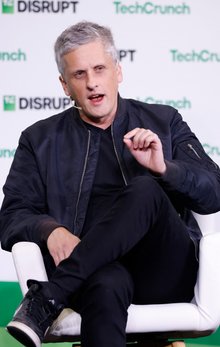
Aaron Levie
CEO

Dario Amodei
CEO and Co-Founder
David Solomon
Chairman & Chief Executive Officer

Matt Comyn

Sam Altman