
How BMW's Leaders are Securing Critical Global Supplies

At a executive roundtable at BMW’s Plant Landshut in Germany, Nicolai Martin, Member of the Board of Management of BMW AG, Purchasing and Supplier Network, and Nadine Philipp, Vice President Sustainability Supplier Network, set out how the group is redefining supply chain resilience.
From renewed US tariffs under Donald Trump to increasing sustainability scrutiny, global headwinds have exposed just how vulnerable complex manufacturing networks can be. The threat by Chinese chipmaker Nexperia to restrict supply to Europe was a particular catalyst, prompting BMW and its peers to reassess risk concentration, supplier dependency and geographic exposure.
For Martin and Philipp, the answer lies in radically better data visibility across every tier of the value chain. By leveraging platforms such as Catena-X, BMW aims to create a common data backbone that strengthens collaboration with suppliers, supports compliance with tightening regulations and enables new circular models within Europe. The goal is clear: a more transparent, agile and sustainable supply network built for the next decade of disruption.
How is the situation for BMW with Nexperia? From the political side, what do you expect from Europe and what are your learnings from this situation?
NICOLAI
This is a topic which keeps me busy on a daily basis. So first of all, I think we are in a similar situation as many other OEM automotive players, but also companies in other industries – we have to understand the impact on the product and on the supply chain.
We do this in a daily exchange with our suppliers because we are not directly ordering parts from Nexperia, we get them included in the products we order from our suppliers.
They are very small and cheap parts but with quite a relevant amount spread over the whole vehicle and therefore we have running transparency activities with our suppliers. They help us to have the transparency we need for our vehicle production and the supporting supply chain.
So far our production still runs as planned but we are in a volatile situation and that can change, but we work with the right measures to avoid this.
The whole topic was created through political aspects and we appreciate that there is such a fast acceleration and deescalation in politics.
But on the other hand the effects we see in the supply chain have to be handled anyhow, even if we see the deescalation.
What other learnings do you have from the situation?
NICOLAI
The learnings are clearly that we were able to have transparency in a few hours because of our experts and the procedures we learned in the chip crisis.
But on the other hand we see that the additional measures after the chip crisis focused more on the chips, the higher value parts, and not so much on these super small and mass product parts.
And it should be investigated further whether we should change something on stock buildup for these components. But that would then also be a task for our suppliers, not directly for us.
How many of these chips are in one car?
NICOLAI
So each single part, most of them only a few cents in value, the order codes are a few hundred in A BMW. There are competitors who need thousands for their product. So the amount is not so big compared to others, but if you look across the supply chain, how many direct first year suppliers are involved, it's still a huge number. All of these parts could be replaced by different sources, it's only a question of lead time and validation time. For some of the parts you can replace them within 24 hours and for others it takes a few weeks.
In the European Union there are very strict regulations in terms of sustainability in the supply chain. Can you measure the impact of those regulations on an OEM like BMW and compared to OEMs from outside Europe?
NICOLAI
The complexity we have to handle in the automotive industry in relation to regulation is really high. There is no other industry with such a level of regulation. To get the approval to sell a vehicle, you have to fulfil I think at the moment around 1,650 rules and regulations. If you compare it with aeroplanes or with products in medicines or so you will never find such an amount of regulations you have to fulfil. And the regulations deviate across regions.
So it is something which leads to high investment in validation infrastructure which leads to high one-off costs to create products that are able to fulfil the regulations and to show them also to the authorities.
In terms of competitors from outside the EU, we have a lot of other companies falling under those regulations. So it is basically not a disadvantage because you also have to follow those regulations if you have a subsidiary in the EU or in Germany. And I think the more regulations we have in that framework, pragmatic and realistic without bureaucratic burdens, which don't really create more impact, that helps us in terms of competitiveness and for sustainability to create more impact.

With BMW's push toward circular production and carbon neutral manufacturing, how are you challenging suppliers to innovate through secondary materials or even digital traceability? And how do you see supplier partnerships evolving from transactional to co-development in early phases?
NICOLAI
We are in constant dialogue with our existing suppliers to search for the right innovations in the product, but also in the production processes and how we work together.
We are also on a daily search for new suppliers, new partners bringing in their innovation and their product ideas.
What is clear to our existing suppliers is that we are not only asking for innovation, but we are strict in our contracts for further partnerships in terms of use of renewable energies. That is accepted without a feeling of pressure because it's part of the negotiations.
For the iX3, it is the first vehicle where we not only collected what was able to be collected, but we clearly negotiated and contracted the use of energy, the use of secondary raw materials and therefore we could secure that progress because it was planned and delivered.
You mentioned the efforts of Catena-X [EDITOR’S NOTE: An open and collaborative data ecosystem for the automotive industry that allows secure exchange of data across the entire value chain]. Can you give us some insights because not all suppliers are following BMW's lead?
NICOLAI
All of the suppliers who want to be competitive and to secure their business, they have to be data-ready. They have to work on their digitalisation, then it's only a small step to enter Catena-X and the ecosystem. Therefore we also support very small suppliers in getting data-ready. And that is done with several measures. But what we see so far as an early player in Catena-X is momentum. Further suppliers are stepping in to close the loop.
You have a Chinese battery cell in the car. Are there plans to make it more European and more German?
NICOLAI
We do everything we can to support value creation here in Europe or in Germany. And every discussion which is ongoing, we are included, but we are not pushing to produce battery cells directly.
How are the emissions measured for the supply and manufacture of the BMW iX3?
NADINE
We managed to do the supplier contracts actually in 2021. So we aligned on the right measures to decarbonise, assessing the CO2-intense processes in the supply chain and in the production of a component. Now, as the car hits the streets, we do an annual verification process to control the energy input, through green energy certificates and power purchase agreements.
We have set up with a third party auditor and audit programme to verify how much we save from that. And we report that in our annual integrated report for the company.
With Catena-X, to what extent is there visibility across the whole value chain?
NADINE
There's a lot of challenges and we don't have the critical mass in Catena in order to see each and every value stage in our supply chains. But that's definitely the vision. And also I don't see another solution – there's no alternative to it.
Today we use a lot of supply chain mapping tools. But in certain regions you can't see certain data. So it has to be something like this collaborative ecosystem to solve that. I don't know of any other movements going in that direction. And from a sustainability perspective, we need that for the primary data, the supplier product, carbon footprint, but also for a lot of legislation upcoming.


Executives
Nadine Philipp
Vice President Sustainability Supplier Network
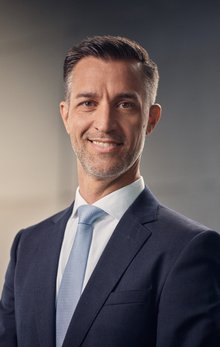
Nicolai Martin
Board Member Responsible for Purchasing and Supplier Network