
Google CEO: Why Vibe Coding Makes Software Exciting Again

Coding used to be something only accessible to the most advanced tech workers, but today people with no experience can do it just as successfully. And this is largely down to vibe coding.
The method of software development where a user describes their desired outcome to an AI tool, which then generates the code based on the prompt, is being used by developers and senior executives across the world to simplify their coding-needs.
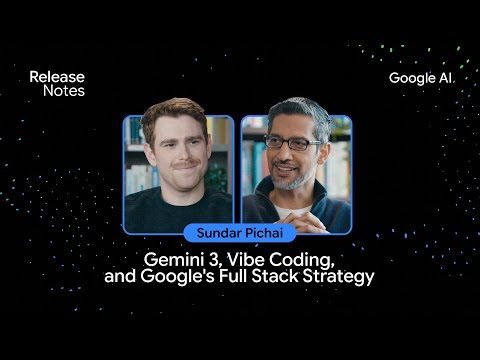
Among them is Google and Alphabet CEO Sundar Pichai, who says “it’s making coding so much more enjoyable”, adding “it’s getting exciting again and the amazing thing is it’s only going to get better now”.
Speaking in a recent Google for Developers podcast interview on 25 November, with Logan Kilpatrick, who runs Google’s AI Studio, Sundar compares the boom in vibe coding to other internet sensations: “You know suddenly blogs appeared, many more people became writers, if you will, and what YouTube did, many more people became creators.”
From HR professionals to marketing leaders, non-technical workers are getting a leg up in being able to visualise ideas directly, according to the Google CEO: “In the past, you would have described it. Now, maybe you’re kind of vibe coding it a little bit and showing it to people.”
The development of AI at Google
Sundar shared the thinking behind going “AI-first” all the way back in 2016, setting up key investments that have steered the company's growth and development.
On 18 November, the firm released Gemini 3, Google’s latest AI model that has new capabilities in reasoning, multimodal understanding and action oriented tasks.
Discussing the release on the podcast, he said the week has been about the excitement of finally releasing the product the company has worked on developing “based on a foundation over many many years and of all the deep investments we built”.
He also discussed Nano Banana Pro, Google’s new image generation and editing model built on Gemini 3 Pro. It excels at creating high-quality visuals, with a particular strength in rendering accurate and legible text in multiple languages.

But despite the developments, Sundar questioned whether these software developments are improving productivity of the world “or is it a net progress”.
Beyond the current releases of Gemini 3 and Nano Banana Pro, he also shared his excitement about long-term bets for the next decade, like quantum computing.
He said: “I think in about five years we’ll be having breathless excitement about quantum, hopefully, like we are having with AI today.”
The rise of vibe coding
The term 'vibe-coding' was coined in February by OpenAI Co-Founder Andrej Kerpathy, who came up with the name to represent how AI can let some programmers “forget that the code even exists” and “give in to the vibes” while making a computer programme.
Sebastian Siemiatkowski, Klarna’s CEO, said on the Sourcery podcast in September that using AI to program allows him to create a prototype in 20 minutes.
The CEO of the Swedish fintech firm said that he has been vibe coding for 20 years but the speed of the work has changed.
What would’ve previously taken a meeting with the tech team and then two weeks of them formulating a prototype, can now be done directly from his desk.
He said: “Rather than disrupting my poor engineers and product people with what is half good ideas and half bad ideas, now I test it myself.”
The Google CEO also said in an interview with The Verge in September: “The power of the future you’re going to be able to create on the web, we haven’t given that power to developers in 25 years.”




Executives
Andrej Karpathy
Sebastian Siemiatkowski
Co-Founder / CEO
Sundar Pichai
CEO