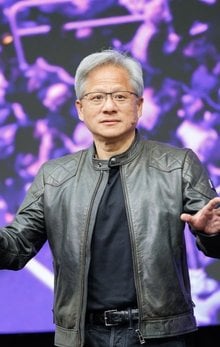
Jensen Huang: How AI will Change the Future of HR at Nvidia
The benefits and implications of AI adoption in the workplace are an ongoing theme for senior leaders.
There’s little doubt, however, that Nvidia's Jensen Huang is the leader of the pro-AI-adoption team. Discussing the technology in his January keynote at CES, one of the world’s largest tech trade shows, he said that “the age of agentic AI is here”.
Jensen believes that AI will not only be used as a tool to assist workers, but will instead be employed just like people - eventually going through a hiring and orientation process to absorb a company’s culture.
In an interview with Citadel Securities published on 15 October, the Nvidia CEO said AI employees will be a “couple-of-trillion dollar market opportunity probably”, with “AI digital nurses, AI accountants, AI lawyers”.
Jensen added: “I wouldn’t be surprised if you licence some and you hire some, depending on the quality and depending on the deep expertise.
“So future workforces in enterprise will be a combination of humans and digital humans.”
Creating and employing a digital workforce
Jensen suggested that the onboarding process of digital employees will be no different to human onboarding, highlighting how passionate he feels about taking pride in the process and imparting culture, philosophies and practices to new hires.
He said: “I tell my CIO, our company’s IT department, they're going to be the HR department of agentic AI in the future.
“Those digital employees are going to work with our biological ones, and that’s going to be the shape of our company in the future.”
Jensen addressed that future AI workers could be based on a range of platforms, including the likes of OpenAI, Harvey, Open Evidence, Cursor, Replit or Lovable.
Specifically highlighting Anysphere-owned Cursor, he said that 100% of Nvidia’s software engineers and chip designers use the AI agent.

This is not a new subject for the CEO. In later October 2024, Business Insider reported that Jensen described a future where the tech giant would mass-deploy AI assistants across every division.
He said that he wants 100 million AI assistants in every group, alongside a 50,000 human-employee company.
Human vs digital workforce
Several globally recognised leaders agree with Jensen’s vision.
At this year’s World Economic Forum in Switzerland, Marc Benioff, Salesforce CEO, said that he and many other CEOs at the event would be the last cohort of executives to lead all-human workforces.
According to Fortune, the leader of the US$320bn software company said: “From this point forward… we will be managing not only human workers but also digital workers.”
Dario Amodei, CEO of Anthropic, was also speaking at the panel and said that by 2026 or 2027, AI systems will be “better than almost all humans at almost all things”.
A large concern for senior leaders - AI taking jobs - was shrugged off by Marc, saying AI workers will “create a higher level of success” and help “deliver a new level of productivity”.
Data support workers’ worries, however, with evidence mounting that recent college graduates are having a harder time finding jobs because companies are relying more on AI.
Dario even warned in a May 2025 interview with Axios that AI could “wipe out half of all entry-level white-collar jobs”.
According to KPMG’s AI Quarterly Pulse survey from June, 87% of business leaders believe AI agents will force organisations to redefine performance metrics and upskill their employees that AI could displace.
Jensen, however, believes in a world where Nvidia will have many digital employees working alongside humans to increase productivity - not by replacing them.
Company portals




Executives

Dario Amodei
CEO and Co-Founder
Jensen Huang
Founder and CEO
Marc Benioff
Chair & CEO