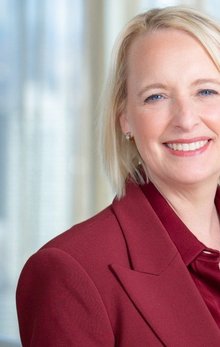
Why Accenture CEO Julie Sweet Says AI Must be Human-Centric

Julie Sweet, Accenture Chair and CEO, has emphasised that AI has shifted from a theoretical tool to a primary growth driver, but urged leaders to focus on human-centric AI deployment and where it is actually needed.
Speaking at the World Economic Forum to Axios, the leader of the consulting firm expressed the need for people to stay ahead. “The future of AI and companies is human in the lead,” Julie said.
She acknowledged that in the firm, the number of employees has decreased but technology has increased, and when it introduced robotic process automation “around 2015”, leaders had “more technology that they’re managing and fewer humans”.
Although she said that this is true today compared to 2015, “that does not change that companies are led by humans and they will win by tapping into human creativity”.
She explained: “I think we need to actually get rid of that narrative because it's not inspiring people to be a human in the loop.”

AI’s effect on the workforce
Julie told Axios’ Mike Allen that AI is not an enemy to the workforce, causing job losses and causing restructuring. She said that the challenge is actually centred around companies choosing to restructure their teams for better processes.
“Many companies today have too many managers, more than they need,” she said, “not because of what AI can do, but they simply have too many managers.
The CEO added that businesses often talk about “fragmented processes, duplication”, but none of this “has anything to do with advanced AI”.
Explaining this idea of not every element of work needs to be integrated with AI, Julie said that too many managers will make the company “probably slower”, so “why would you create an agent to replace a manager that you actually don’t need today rather than get your organisation ready to be fast and lean”.
The gap between AI expectations and reality
Referring to a recent Accenture study about the adoption of AI, Mike raised the findings of the gap between leadership vision and worker perception.
Julia said this is partially down to what is in the media and what leaders are actually saying, adding that the media says “we’re not hitting productivity and so on” whereas “78% of the leaders [in the study] said they think the greatest promise for AI is growth not productivity."
The difference between productivity and growth is often confused, Julie said, outlining that “productivity is a nice way of saying saving money, where growth is more revenue”.
AI is a top down process
The CEO also expressed the need for a greater understanding that AI for implementation should be both trusted and successful. For this to happen, she says, requires input and action from leadership teams, not just the tech teams.
“When Accenture first started on our journey, the first thing we did was take our top 50 leaders,” Julie explained. “They got the most training in the first few months because if you don’t have the leaders understanding it, they can’t explain it to our people. They can’t drive the transformation.”
She added that “trust is built through understanding and transparency”.

This fully engaged approach has led Accenture’s AI strategy into a multi-billion-dollar, comprehensive and client-focused approach designed to position the company as the “reinvention partner” of choice in the age of Gen AI.
Centred on accelerating AI adoption to drive business value, this strategy aims to move companies beyond isolated experiments to full-scale enterprise transformation.
As Julie explained in Davos, for AI to generate growth, companies must keep people at the centre of the adoption, in terms of their understanding and ability to use it as an addition to a strong workforce, not instead of.
Company portals

Executives
Julie Sweet
Chair