
How Safra Catz is Powering Oracle’s Hypergrowth Journey
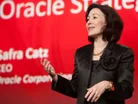
Tech firms benefiting from the AI boom is hardly news. But there’s benefitting, and then there’s the kind of growth that cloud firm Oracle has seen recently.
Last week the company announced its fiscal year 2026 Q1 results, setting out impressive performance that signalled enormous demand for its cloud services and saw company stock climb 36% – described by the likes of Nasdaq as the best single-day performance since 1992.
Oracle said that remaining performance obligations were up 359% and valued at US$455bn, indicating a huge backlog of future revenue from signed contracts, particularly for its AI-driven cloud services.
This figure, as well as a quarterly revenue of US$14.9bn – up 12% in USD – saw the company gain US$244bn in market cap, reaching a total market value of around US$922m.
Even CEO Safra Catz acknowledged the extent of the numbers, saying: “It was an astonishing quarter – and demand for Oracle Cloud Infrastructure continues to build.
“We signed four multi-billion-dollar contracts with three different customers in Q1,” said Safra, noting that “Oracle is off to a brilliant start to FY26.”

AI is everything
Safra's own net worth rose by about US$412m on 11 September following Oracle’s announcement.
According to a Forbes estimate, the jump happened in the first six hours of trading on the New York Stock Exchange.
The CEO heads up the company with Executive Chairman and CTO Larry Ellison.
Ellison’s own net worth surged to US$393bn on 10 September, briefly surpassing Elon Musk’s and making him the world’s richest person (the firm’s share price lost some of its gains by the end of the day, pushing Musk back to the number one spot).
“We expect MultiCloud revenue to grow substantially every quarter for several years as we deliver another 37 data centres to our three Hyperscaler partners, for a total of 71,” Ellison said.
"Oracle AI Cloud Infrastructure and the Oracle MultiCloud AI Database will both contribute to dramatically increasing cloud demand and consumption over the next several years. AI Changes Everything.”
Who is Safra Catz?
Safra joined Oracle as a Senior Vice President in 1999, having previously spent more than a decade in investment banking.
She climbed the ladder quickly at the business, being appointed to the company’s board of directors in 2001 before becoming President of the company in 2004.
When Ellison stepped down as the firm’s Chief Executive in 2014, Safra was named joint CEO alongside Mark Hurd, taking the role on alone when Hurd stepped down for health reasons in 2019.
Shaping Oracle’s transformation strategy
Safra is often credited with leading Oracle’’s growth and transformation, with her leadership style recognised for its focus on financial discipline, data-driven decision making and focus on collaboration and accountability.
As CFO in the early 2000s she is credited with playing a decisive role in Oracle’s merger and acquisition strategy, overseeing the acquisition of dozens of companies that supercharged the firm’s growth including PeopleSoft, Siebel Systems, Hyperion and Sun Microsystems.
Under her leadership as CEO, Oracle has moved more decisively into cloud and AI infrastructure, adapting to changing market demands and renewing its relevance.
In particular she has played a key role in shaping Oracle’s strategy to be more competitive with hyperscalers like Amazon, Microsoft and Google by emphasising AI, data centres, cloud infrastructure and key partnerships.
Discussing the company’s evolution in an interview with Cloud Wars, Safra has previously said: “transforming yourself and modernising yourself – that’s not a destination, it’s a constant journey.
“In fact, any time you stop, your competitors are going to pass you. And one of the reasons that businesses succeed is when they’re adaptable and when they’re absorbing those new technologies.
“But those that sort of stick with what they have? They get passed over.”