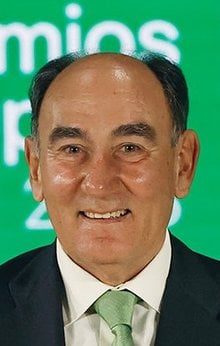
Ignacio Galán: Lessons From Iberdrola's Influential Leader

Few figures in the global energy sector command the influence of José Ignacio Sánchez Galán, better known simply as Ignacio.
As Executive Chairman and de facto leader of Iberdrola, one of the world's largest, fastest-growing and most valuable utility companies, Ignacio holds considerable sway over the direction of the global energy transition.
Under his leadership, Iberdrola has positioned itself as one of the world's most sustainable companies, operating a renewables portfolio that rivals almost any company globally.
His work has attracted considerable attention from industry observers and he is frequently cited as a reference point for executives pursuing sustainability objectives.
Early career trajectory
When Ignacio became Executive Vice-Chairman and CEO of Iberdrola in 2001, the extent of the transformation he would lead was difficult to anticipate.
Born in Salamanca in 1950, his professional background originated outside the energy sector.
His early career was spent at Sociedad Española del Acumulador Tudor, where he oversaw international expansion initiatives.
His path subsequently took him into telecommunications, serving as CEO of Airtel Móvil during Spain's sector liberalisation, and aerospace, where he chaired Eurojet and led Industria de Turbopropulsores from its establishment.
However, it was at Iberdrola – where he became Executive Chairman in 2006 – that he would make his most significant impact.

Building renewable infrastructure at scale
Under Ignacio's leadership, Iberdrola has deployed more than US$165bn in renewable energies, smart grids, energy storage and green hydrogen.
The company has evolved from a predominantly Spanish utility into Europe's largest by market capitalisation, reaching approximately US$142bn by the beginning of 2026.
At the end of the first nine months of 2025, Iberdrola operated 45,263MW of renewable capacity.
The company supplies energy to nearly 100 million people across dozens of countries through subsidiaries including ScottishPower in the UK, Avangrid in the US and Neoenergia in Brazil.
Iberdrola's Strategic Plan for the next three years outlines US$64bn in investments, with US$37bn in distribution and transmission infrastructure, primarily in the UK and US.
"The opportunities that the United States offers at the moment are great," he said recently on Bloomberg TV.
The renewables portfolio receives US$23bn, with 38% dedicated to offshore wind. By 2028, Iberdrola expects to exceed 60GW of installed renewable capacity, with 75% already under construction or ready to build.
Global influence and future outlook
Ignacio's role extends beyond corporate leadership. His position in the global energy market was demonstrated at COP30 last November, where he was one of only 10 private sector figures invited to speak with world leaders at the conference's opening discussions.
He serves as chair of the Electricity Cluster at the World Economic Forum and sits on the steering committee of the European Round Table of Industrialists.
His advisory roles include membership on MIT's Presidential CEO Advisory Board.
In 2019, the Harvard Business Review selected Ignacio as one of the five most important CEOs in the world and the first in the utilities sector.
In 2014, Queen Elizabeth II appointed him honorary Commander of the Most Excellent Order of the British Empire for promoting the British energy sector.
However, Ignacio's tenure has included legal scrutiny. In 2022, he testified privately in Spain's High Court regarding an investigation into alleged corporate espionage and bribery between 2004 and 2017.
At 75 years old, Ignacio continues to advocate for accelerated electrification through renewables.
"We need to accelerate the expansion of electrification through renewables to reduce our dependence on fossil fuels," he says. "Tripling renewables by 2030 is feasible and will mobilise investments of $2.4tn a year."
For an industry managing the pace and scale of energy transition, Ignacio's quarter-century track record at Iberdrola provides a case study for observation.
For now, Iberdrola's performance indicates the strategy is attracting investor and customer support at levels few other companies have achieved.