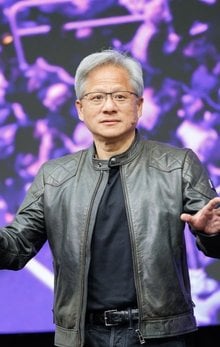
Inside Jensen Huang’s Meeting with Trump Amid AI Chip Debate
Nvidia CEO Jensen Huang visited Washington this week for a high-profile meeting with President Donald Trump, as the administration considers whether to loosen restrictions on sales of Nvidia’s advanced AI chips to China.
The conversation comes at a pivotal moment for the world’s most valuable chipmaker, which has been pushing for more predictable export rules while navigating political scrutiny from both parties.
Trump confirmed the meeting on 3 December, telling reporters, according to Reuters, that Jensen understood his stance on export controls.
When asked whether he had made clear to the Nvidia CEO his views on which chips could be sold to China, Trump replied: “He knows.” When pressed further about Jensen, the President added: “Smart man.”
According to CNBC, Nvidia’s leader described the conversation similarly, saying that he and the President “talked in general about export controls”.
He did not elaborate on specifics, though the discussion took place as administration officials are weighing whether to permit the tech firm to sell its H200 processors into the Chinese market.
Jensen’s H200 is a data centre GPU designed for generative AI and high-performance computing and succeeds the H100.
Nvidia has said it supports US national-security objectives, with Jensen saying to reporters on Capitol Hill, according to CNBC: “I’ve said it repeatedly that we support export controls, and that we should ensure that American companies have the best and the most and first.”
Debate over US chip policy intensifies
The Washington visit coincided with congressional negotiations over the Guaranteeing Access and Innovation for National Artificial Intelligence (GAIN AI) Act. The Bill would require Nvidia and other chipmakers to offer AI processors to US companies before selling them to what government officials refer to as “countries of concern”, including China.
Bloomberg reported that the proposal isn’t expected to be a part of the National Defence Authorisation Act, citing a person familiar with the source.
Jensen told reporters: “The GAIN AI Act is even more detrimental to the United States than the AI Diffusion Act.” He also reportedly criticised state-by-state AI regulation, arguing that uneven rules would slow down innovation and weaken US competitiveness.
“State-by-state AI regulation would drag this industry into a halt,” Jensen said according to CNBC, “and it would create a national security concern, as we need to make sure that the United States advances AI technology as quickly as possible.”
A federal AI regulation is the wisest.
China’s willingness to buy the H200
In separate comments reported by Bloomberg, Jensen said it was uncertain whether Beijing would even allow Chinese companies to purchase the H200 if the US relaxed restrictions.
Asked about China’s willingness to accept the processors, he said: “We don’t know. We have no clue.” He added that Nvidia cannot intentionally reduce chip capabilities to meet US standards because “we can’t degrade chips that we sell to China, they won’t accept that.”
When the Nvidia Chief was asked how often he comes to Washington, he said: “Whenever President Trump would like me to be here.”

Chip smuggling claims
Jensen later addressed concerns about illegal shipments of restricted GPUs during an event hosted by the Centre of Strategic and International Studies, as reported by Reuters.
He dismissed the idea that banned high-performance processors were being smuggled in meaningful quantities, pointing to their scale and complexity: “A GPU for AI data centres, that GPU weighs two tons. It has one and a half million parts. It consumes 200,000 watts. It cost US$3m.
“Every so often somebody says, you know, these GPUs are being smuggled. I really would love to see it - not to mention you have to smuggle enough of them to fill a football field.”
Even if some reports say Nvidia is poised to win the policy battle, the broader debate of how to balance national security, technological leadership and global market access will continue.
The administration’s decision on the H200 remains large, and Jensen’s meeting with the President underscores how central Nvidia has become in AI’s geopolitical competition.
Company portals


Executives
Jensen Huang
Founder and CEO