Jensen Huang's CES Spotlight: NVIDIA's Next AI Move
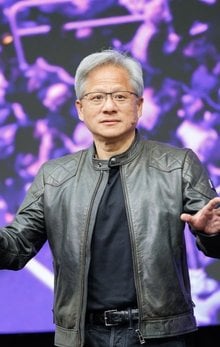
When Jensen Huang, NVIDIA CEO, took to the stage at the Consumer Electronics Show (CES) in Las Vegas on 5 January, his message was clear: AI is entering a new phase, powered by faster and even more specialised chips.
At the heart of NVIDIA’s announcement was the confirmation that its next generation of AI processors is already in “full production”, according to the CEO.
Jensen told the CES audience that the company’s forthcoming chips, due to arrive later in 2026, can deliver “five times the artificial intelligence computing” of NVIDIA’s previous generation when running chatbots and other AI applications.
Executives told Reuters that the chips are already in NVIDIA’s labs being tested by AI firms, even as rivals and major customers push to develop their own alternatives.

A new generation of development
At the centre of the announcement was the Vera Rubin platform, named after the US astronomer, which is said to be shipped to customers like Amazon and Microsoft in the second part of 2026.
Made up of six separate NVIDIA chips, the server will contain 72 of NVIDIA’s graphics processing units and 36 of its new central processors.
Jensen demonstrated how these systems can be linked together into “pods” containing more than 1,000 Rubin chips, dramatically increasing the scale at which AI models can be deployed.
According to the CEO, the gains are not simply a matter of brute force, but the Rubin chips use a proprietary kind of data that NVIDIA hopes will be adopted more widely across the industry.
He said: “This is how we were able to deliver such a gigantic step up in performance, even though we have 1.6 times the number of transistors.”
Much of Jensen’s keynote focused on so-called inference, the task of delivering AI-generated responses to millions of users in real time. While NVIDIA still dominates the training of large AI models, it faces far greater competition in this area from other companies, including AMD, Intel and others that became key players in the race in 2025.
To address this, NVIDIA announced a new layer of storage called “context memory storage”, designed to help chatbots provide faster and more coherent responses to long questions and conversations.
From AI to driverless cars
Beyond AI chips, Jensen also used CES to highlight NVIDIA’s ambitions in autonomous driving. He announced the wider release of Alpamayo, a new AI model for self-driving cars that the company had previously shown as research.
Jensen said that Alpamayo would be released along with the data used to train it to allow carmakers to evaluate its performance.
He said to the audience: “Not only do we open-source the models, we also open-source the data that we use to train those models, because only in that way can you truly trust how the models came to be.”
The CEO also described Alpamayo as the “world’s first thinking, reasoning autonomous vehicle” system with AI that “can teach the car how to drive”.
He added: “Not only does it take sensor input and activate the steering wheel, brakes and acceleration, it also reasons about what action it is about to take.”
According to The New York Times, Mercedes-Benz will begin shipping cars equipped with NVIDIA self-driving technology in 2026.
Jensen framed these advances as part of a broader economic shift driven by AI. He said that “the computer industry is being reinvented” and that “some US$10tn or so of the last decade of computing is now being modernised to this new way of doing computing”.
As CES continued, the Jensen’s message resonated beyond NVIDIA. With its rivals, including Intel and AMD, preparing their own announcements, his keynote underscored how rapidly AI hardware and software are evolving, and how central his company intends to remain to that transformation.
Company portals




Executives
Jensen Huang
Founder and CEO