How Nvidia has Become the World's Most Valuable Company
It had to happen: Nvidia is the most valuable company in the world, and the first to reach a market capitalisation of US$5tn.
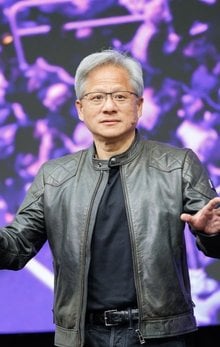
The news follows a series of strategic announcements by CEO Jensen Huang at the company’s GTC Washington, DC event.
There, he laid out the company’s vision for the future, including details of new partnerships and technologies that signal expanding ambitions beyond Nvidia’s core chip-making business into telecommunications, transport and enterprise AI infrastructure.
Nvidia also reported US$500bn in bookings for its new Blackwell and Rubin chips over the next five quarters, indicating sustained demand for its hardware. At the event, Jensen outlined a vision for Nvidia focused on future technological shifts and industrial innovation.
“We are going through a platform shift,” he said. “That shift is a once in a lifetime opportunity for us to get back into the game for us to start innovating with American technology. Today we are announcing that we are going to do that.”

Nvidia's foray into 6G telecommunications
A key announcement was a US$1bn partnership with Nokia, the world's second-largest telecommunications equipment manufacturer.
This collaboration will see Nvidia’s accelerated computing and AI capabilities integrated with Nokia’s telecommunications hardware. According to Jensen, the partnership aims to position America at the centre of the upcoming 6G revolution.
The technology at the heart of this initiative is Nvidia’s new ARC (Aerial RAN Computer) product line, a 6G-ready wireless computing system built on three core components: the Grace CPU, the Blackwell GPU and Mellanox ConnectX networking.
It functions as a software-defined programmable computer capable of handling both wireless communication and AI processing.
Nokia will integrate the ARC system, which runs on the CUDA-X library, into its base stations globally.
Justin Hotard, President and CEO of Nokia, said: “The next leap in telecom isn’t just from 5G to 6G, it’s a fundamental redesign of the network to deliver AI-powered connectivity, capable of processing intelligence from the data centre all the way to the edge.”
“Our partnership with Nvidia, and their investment in Nokia, will accelerate AI-RAN innovation to put an AI data centre into everyone’s pocket.”
AI supercomputers and quantum advancement
Nvidia has also revealed a collaboration with the US Department of Energy (DOE) to advance national scientific research. “Today we are announcing that the Department of Energy has partnered with Nvidia to build seven new AI supercomputers to advance our nation’s science,” said Jensen.
A central part of this initiative is a new interconnect architecture called NVQLink, which directly connects quantum processors with Nvidia GPUs.

This system is designed to move terabytes of data between quantum and classical hardware to perform error corrections.
This quantum-GPU computing model is powered by CUDA Q, Nvidia’s platform for quantum computing.
The NVQLink architecture allows for hybrid simulations where quantum processing units (QPUs) and GPU supercomputers work together, potentially advancing performance beyond what classical computing can achieve alone.
Jensen described this integrated approach as the future of quantum computing.
Autonomous transport and enterprise AI
Expanding its reach into the mobility sector, Nvidia has partnered with Uber to support the development and deployment of autonomous vehicles.
Dara Khosrowshahi, CEO of Uber, explains: “Nvidia is the backbone of the AI era, and is now fully harnessing that innovation to unleash L4 autonomy at enormous scale, while making it easier for Nvidia-empowered AVs to be deployed on Uber.
“Autonomous mobility will transform our cities for the better, and we’re thrilled to partner with Nvidia to help make that vision a reality.”
The partnership will utilise Nvidia’s Drive Hyperion, a reference compute and sensor architecture for vehicle manufacturers to create robo-taxi-ready models.
Uber’s plans include deploying 100,000 autonomous vehicles in 2027 supported by an AI factory built on the Nvidia Cosmos platform.
In the enterprise software space, Nvidia announced a partnership with Palantir to create an integrated operational AI technology stack.
This will combine Nvidia’s accelerated computing and CUDA-X libraries with Palantir’s Ontology framework.
Alex Karp, Co-founder and CEO of Palantir Technologies, states: “Palantir is focused on deploying AI that delivers immediate, asymmetric value to our customers. We are proud to partner with Nvidia to fuse our AI-driven decision intelligence systems with the world’s most advanced AI infrastructure.”



Executives
Dara Khosrowshahi
CEO
Jensen Huang
Founder and CEO
Justin Hotard
President and CEO