How Palantir CEO Alex Karp Thinks AI Could Transform Work

Palantir CEO Alex Karp says the future of work amid the AI boom will position vocational skills in high demand and that people in the tech industry are underestimating how disruptive AI will be.
Alex has previously highlighted Palantir’s focus on skill-based hiring, prioritising candidate problem solving ability and learning speed over resume prestige.
As AI implementation continues across global industries, workers are looking to find ways to future-proof their roles to avoid being replaced by the technology, particularly across roles in data entry, customer support and entry-level coding.
Speaking in an interview with TBPN, Alex said that not all types of work will be negatively affected by AI development.
"There are basically two ways to know you have a future. One, you have some vocational training. Or two, you're neurodivergent,” he said.
Alex used the term “neurodivergent” broadly (including conditions like ADHD, autism and dyslexia), and discussed how those with said diagnoses are more likely to take unconventional career paths.
He suggested that individuals who make non-traditional choices are more likely to find new opportunities in an AI-driven environment.
The end of white-collar work
Alex explains the disruption around AI and workforces will largely affect white-collar work, referring to executive, managerial and administrative-type roles.
And he’s not alone. In an interview with CNN, Anthropic CEO Dario Amodei claimed that AI could eliminate entry-level white-collar jobs within five years, and suggested that AI will “get better than humans at almost all intellectual tasks”.
In a self-published essay, he discussed this further, saying: “The pace of progress in AI is much faster than for previous technological revolutions.
“It is hard for people to adapt to this pace of change, both to the changes in how a given job works and in the need to switch to new jobs.”
While Alex shares some of these sentiments, particularly around the disruption AI may have at an executive level. He also believes that those in labour-centric roles will see their economic power considerably boosted.
"This technology disrupts humanities-trained – largely Democratic voters – and makes their economic power less, and increases the power, economic power, vocationally trained, working class, [...] these disruptions are going to disrupt every aspect of our society," he said in an interview with CNBC.

Journalists suggest that while AI automation may play a role in affecting the work and political landscape, the idea that AI will erode civil liberties and work culture is merely Alex’s interpretation of events to come.
In an article for Bloomberg, Senior Editor Walter Frick discusses the impact of AI on entry-level work, saying: “Coverage of AI threatening entry-level jobs has been so extensive that the narrative is starting to feel like common sense.
“But there’s no economic rule that dictates a new technology will hurt [entry-level] workers most; often it’s the reverse.”
An unconventional hiring process
Following on from his desire to uphold vocational skills, Alex has called for an overhaul of the US education system to better value vocational skills.
He argues that the US could improve upon its tests to measure aptitude across different fields of education and industries.
“All of our tests are built around things that were valuable in the industrial revolution,” he said. “It's like you want to pull out all the dyslexics, all the neurodivergence, everybody who can't sit, or needs to build, or wants to build.”
In an effort to source talent from non-traditional routes, Palantir has created a Neurodivergent Fellowship, a programme designed to challenge the traditional hiring practices and focus on the individual merit of each candidate.
Company portals

Executives
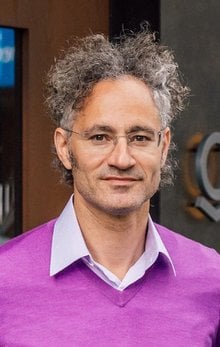
Alex Karp
CEO
Walter Frick
Senior Editor