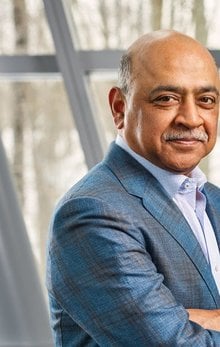
IBM CEO: No Return on Trillions in Data Centre Spending

AI companies are spending billions on data centres in the race to the top, with Google CEO Sundar Pichai hinting at possible future developments in space.
Discussing the development of future data centres on the “Decoder” podcast with host Nilay Patel, IBM CEO Arvind Krishna says: “There’s no way you’re going to get a return on that in my view because eight trillion of capex means you need roughly 800 billion of profit just to pay for the interest.”
Calculating based on today’s costs “because anything in the future is speculative”, Arvind says it takes about US$80bn to fill up a 1 gigawatt data centre, “so if you’re going to commit 20 to 30 gigawatts, that’s one company, that’s a 1.5 trillion of capex”.
Acknowledging the depreciation of AI chips inside data centres, he adds: “You’ve got to use it all in five years because at that point, you’ve got to throw it away and refill it.
“If I look at the total commits in the world in this space, in chasing AGI [Artificial General Intelligence], it seems to be 100 gigawatts with these announcements.”
Based on Arvind's calculations, US$80bn for each 100 gigawatts, sees the computing commitments priced at US$8tn.

OpenAI on AGI
After Arvind shared his calculations, Nilay asked “Have you told Sam?”, referring to OpenAI’s CEO Sam Altman who believes the AI company can generate returns on capex.
Arvind responded: “It’s a belief that one company is going to be the only company that gets the entire market. That’s a belief. That’s what some people like to chase. And I understand it from their perspective. That’s different than I agree with.”
He added that some people will make money and some will lose money, but he is not convinced “that the current set of known technologies gets us to AGI”.
AGI is seen as the next step in AI developments, opening up greater scope and adaptability. While current AI excels at performing specific, pre-programmed tasks, the theoretical concept of AGI is that it will possess human-like cognitive abilities.
This could include having common sense, an ability to reason and to keep learning continuously.
Arvind thinks it could be achieved by fusing knowledge with large language models (LLMs), but says “I’m not like 100%”. Without another technological breakthrough, he says the chance of achieving AGI is about 0-1%.
CEOs discuss data centres
Speaking on the “Google AI: Release Notes” podcast at the end of November, Google CEO Sundar Pichai shared his visions of space data centres - an idea he admits seems “crazy”.
Although he said that “when you truly step back and envision the amount of compute we’re going to need, it starts making sense and it’s a matter of time”.
Sundar was referring to Google’s Project Suncatcher, which he describes as “a moonshot exploring a new frontier: equipping solar-powered satellite constellations with TPUs and free-space optical links to one day scale machine learning compute in space”.
According to research by Google launched on 4 November, prices of space launches are falling so quickly that by the mid-2030s the running costs of a space-based data centre could be comparable to one on earth.
Back on earth in its recent Q3 2025 earnings call, Meta, led by CEO Mark Zuckerberg, emphasised a strategy of aggressively increasing investment in data centres to support its significant AI ambitions.
The tech firm raised its full-year 2025 capex guidance to between US$70 and US$72bn, with a warning that 2026 spending would be “notably larger” - primarily driven by the need for AI infrastructure.
Despite being sceptical about the realities of delivering AGI any time soon, Arvind says on the podcast: “I think it’s going to unlock trillions of dollars of productivity in the enterprise, just to be absolutely clear.”