Why did Blackrock CEO Larry Fink Open Davos with a Warning?

When one of Wall Street’s most powerful and influential figures warns of the state of global capitalism and the risks posed by emerging technologies it pays to listen.
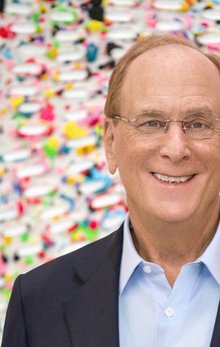
Which is why BlackRock CEO Larry Fink’s opening remarks at the World Economic Forum in Davos, Switzerland mark a statement of intent for the nearly 1,000 business leaders and 65 heads of state and government gathered.
Larry was appointed interim co-chair of the World Economic Forum’s board of trustees in 2025, alongside Vice Chairman of Roche André Hoffmann.
In his opening remarks on Tuesday 20 January, he offered a stark message: the rapid growth and adoption of AI risks damaging the future prospects of the world’s working classes, and having a lasting impact on prosperity.
This, he said, could be capitalism’s greatest challenge, particularly in an increasingly complex and competing world.

How innovation impacts prosperity
Larry told those present that discussions about the future potential of AI to businesses and society must involve everyone, not just the global elite.
He warned: “Since the fall of the Berlin Wall, more wealth has been created than in all prior human history combined. But in advanced economics, that wealth accrued to a far narrower share of people than any healthy society can sustain.”
Larry said that the rise of AI globally could repeat the same pattern. “Early gains are flowing to the owners of models, data and infrastructure,” he explained. “The open question is what happens to everyone else.
“If AI does to white-collar work what globalisation did to blue-collar, we need to confront that directly. Not with abstractions about 'the jobs of tomorrow', but with a credible plan for broad participation in the gains.”
He stressed: “This is the test: Whether capitalism can evolve to turn more people into owners of growth—instead of spectators watching it happen.”
The BlackRock CEO, who has been CEO since co-founding the firm in 1988, has used previous speeches at Davos to discuss ways in which capitalism should adapt to better share prosperity and address long-term global challenges.
In past years, he has discussed how businesses can help advance this agenda, notably advocating for stakeholder capitalism – a model where firms serve not just shareholders but also employees, communities and the environment.

Leading a broader conversation
In order to drive change, Larry called for the gathering to rethink its legitimacy by ensuring critical global discussions are not the preserve of big business and government alone.
“This forum can’t remain an echo chamber,” he said. “And we shouldn’t want panels where everyone agrees 95% of the time. Because the world doesn’t.
“Most of the people affected by what we talk about here will never come to his conference. That’s the central tension of this forum: Davos is an elite gathering trying to shape a world that belongs to everyone.”
He encouraged business leaders and their organisations to focus on transparency and trust as core mechanisms of change, saying: “We’re here for something bigger than ourselves and the organisations we represent.
“We believe economic progress should be shared. We believe prosperity should reach further than it has. And we believe institutions like WEF still matter in making that happen.”
AI dominates the Davos conversation
The growth, adoption and return on AI has been a central theme at Davos. Ahead of the event, consulting firm PwC released its latest Global CEO Survey, which found that despite growth, leaders are still struggling to see a return on AI investment.
According to Mohamed Kande, PwC Global Chairman: "2026 is shaping up as a decisive year for AI.
"A small group of companies are already turning AI into measurable financial returns, whilst many others are still struggling to move beyond pilots. That gap is starting to show up in confidence and competitiveness, and it will widen quickly for those that don't act."
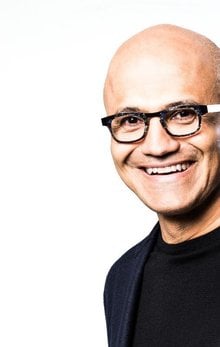
During a panel conversation at Davos on 21 January, Larry discussed AI investment and bubble concerns with Microsoft CEO Satya Nadella.
He said: “I think there will be big failures, but I don’t think we are in a bubble,” placing the wave of AI investment within the context of wider global geopolitics by explaining “I think for the Western economies, if we don't cooperate, if we don't scale, China wins.”
Looking at the potential benefits of the technology, he said: “The key to that is making sure that the demand only comes if technology is diffused for more applications, more utilizations. If technology is just the domain of the six hyperscalers, we will fail.”
Satya believes that the pace of AI innovation means the technology has already surpassed potential bubble effects.
“So many people talk about there may be an AI bubble,” he said. “The most important thing that we see as an investor is the democratisation of technology and the diffusion of that technology really does then transform the demand, and the companies or the countries that diffuse it fastest are going to be the ultimate winners, not the technology creator.”
He stressed that the conversation should shift beyond technology, stating that the power of AI needs to be focused on improving the outcomes of everything ranging from health to education.


Executives
Larry Fink
Chairman and Chief Executive Officer
Satya Nadella
Chairman and CEO